Capital Gains and Losses: How They're Taxed and What to Know
The information in this material is not intended as tax or legal advice and may not be used for the purpose of avoiding any federal tax penalties. Please consult legal or tax professionals for specific information regarding your individual situation.
Capital gains result when you sell an investment for more than you paid for it. How those gains are taxed depends largely on how long you held the asset before selling.
Short-Term vs. Long-Term Capital Gains
A short-term capital gain applies to assets held one year or less and is taxed at ordinary income tax rates. A long-term capital gain applies to assets held longer than one year and is taxed at preferential rates — which are generally lower than ordinary income rates.
The long-term capital gains tax brackets are as follows:
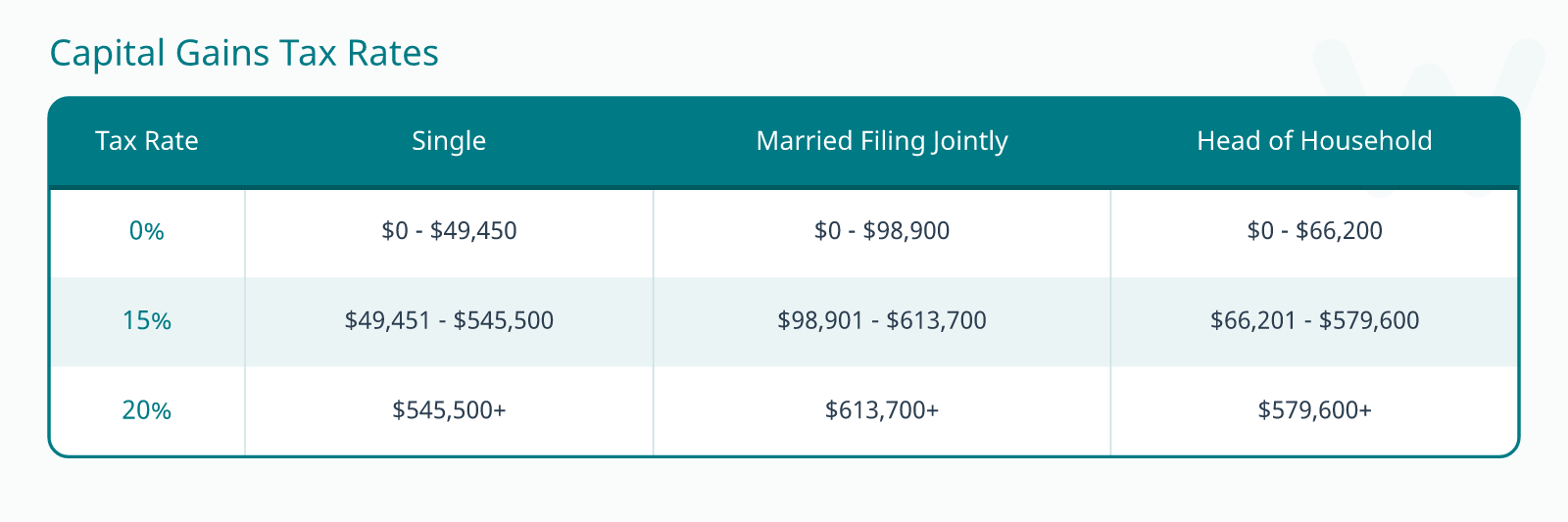
Taxpayers with adjusted gross income above $200,000 (single filers or heads of household) or $250,000 (joint filers) may also be subject to an additional 3.8% net investment income tax on top of those rates.² The long-term capital gains rate for collectibles and precious metals remains at a maximum of 28%.³
How Capital Losses Work
Capital losses can be used to offset capital gains. If your losses exceed your gains in a given year, up to $3,000 of those excess losses may be applied to offset taxes on other types of income. If your losses exceed $3,000, the remainder can be carried forward to future tax years, where they can offset future gains. Under current law, the ability to carry forward these losses ends at death.⁴
For some assets, calculating a capital gain or loss is more complex than it may appear. Before making tax-related decisions involving investments, it's worth consulting a tax professional.
If you have questions about how capital gains may affect your investment strategy, let's talk.
Sources:
1. IRS.gov, 2025
2. IRS.gov, 2025
3. IRS.gov, 2025
4. IRS.gov, 2025
Ready to talk strategy? See our current services.
Brent Forrest & Associates, LLC. dba Wela Financial Advisory (Wela) is a registered investment adviser. The information presented is for educational purposes only. It should not be considered specific investment advice, does not take into consideration your specific situation, and does not intend to make an offer or solicitation for the sale or purchase of any securities or investment strategies. Investments involve risk and are not guaranteed. Be sure to consult with a qualified financial adviser and/or tax professional before implementing any strategy discussed herein. This article and images may have been enhanced by utilizing artificial intelligence (AI). Wela may discuss and display, charts, graphs, formulas which are not intended to be used by themselves to determine which securities to buy or sell, or when to buy or sell them. Such charts and graphs offer limited information and should not be used on their own to make investment decisions.

